LLMjacking attacks on cloud AI: how a stolen key becomes your bill
A stolen AI API key opens the door to your bill more than to your data: the attacker uses the models and the company pays. Knowing how those keys get lost is the first step to limiting the damage.

On this page
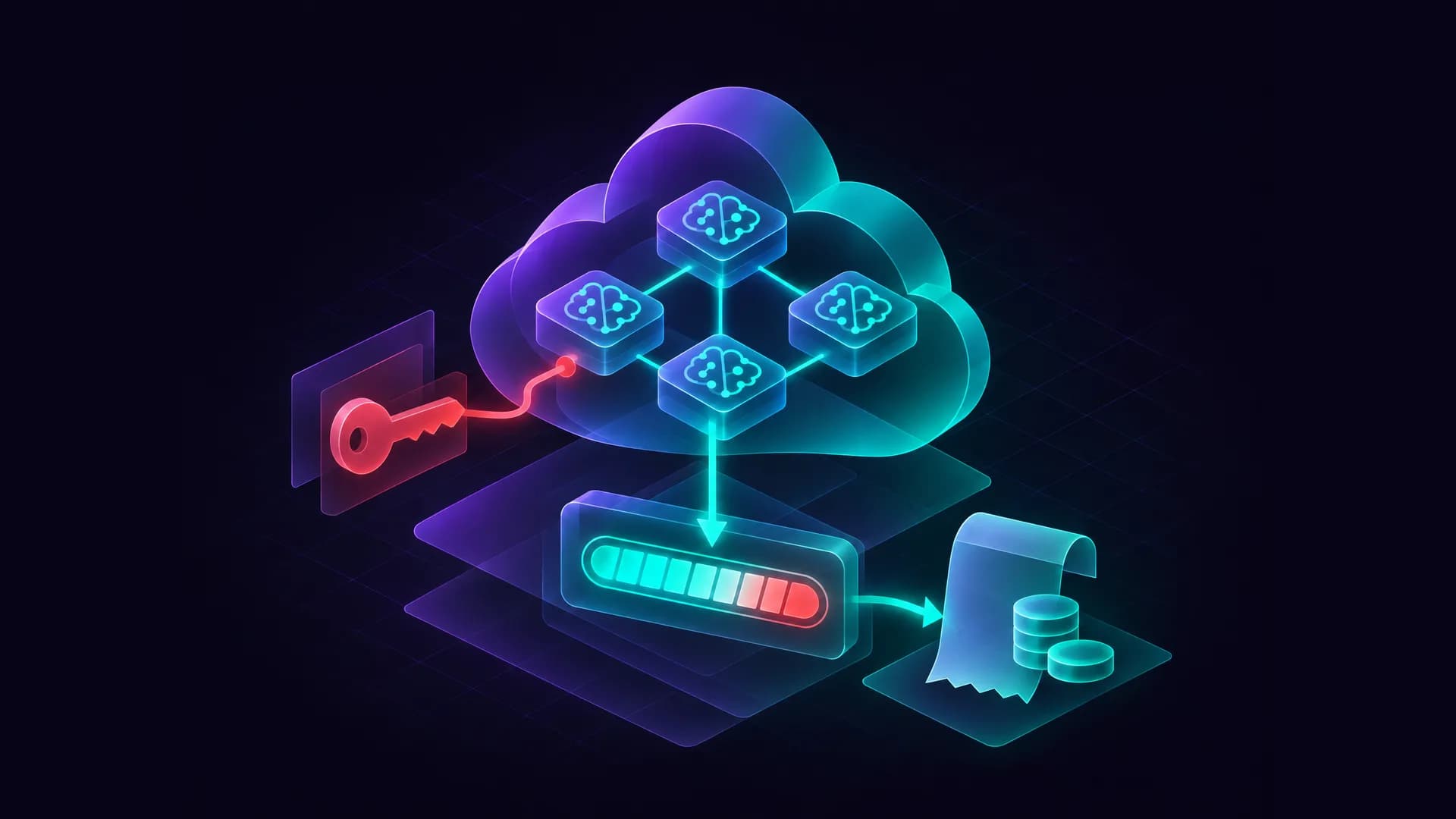
Nobody at the company has used the AI assistant any more than usual and yet the cloud provider's charge shoots up overnight. Behind that anomaly there may be LLMjacking attacks on cloud AI, a threat Google warned about and The Hacker News and BleepingComputer reported [1][2].
The thesis of this analysis is simple. LLMjacking is not an exotic technique but a problem of credential and cost governance: an AI key with no clear owner, no limited scope and no spending cap turns the company's account into a resource for the attacker.
What LLMjacking is: it hijacks your access to the models and leaves you the bill
According to The Hacker News, which reports Google's warning, LLMjacking is a variant of resource hijacking adapted to the era of large language models (LLMs): the attacker obtains an application programming interface (API) key, gets into an organisation's language-model accounts and lets the legitimate owner pay for the consumption [1].
The nuance matters. A stolen API key can let someone generate spend in its owner's name. That is why the main damage need not be a data leak, but an invoice nobody authorised.
The same outlet reports a comparison by Google Threat Intelligence Group (GTIG) and Mandiant that helps size the risk: unlike the slow, gradual consumption of cryptojacking, LLMjacking can cause sudden spikes of fraudulent charges within hours [1]. That speed is what turns a configuration oversight into a financial problem.
Keys are lost through ordinary routes: phishing, leaked code and misconfigured environments
The sources describe entry routes such as phishing, code leaks and misconfigurations. The Hacker News lists the ways attackers obtain stolen AI API keys: phishing, source code leaks, misconfigured environments and code exposed on the client side [1]. It adds that the most common initial access vector has been exposed or stolen cloud identity tokens, including identity and access management (IAM) credentials, service account keys, personal GitHub tokens and active session tokens [1].
BleepingComputer, citing GTIG and Mandiant researchers, distinguishes two attacker profiles: those who scan for publicly exposed LLM endpoints and those who steal valid API keys from unprotected machines [2]. Neither needs an unknown vulnerability; they only need to find what someone left in plain sight.
The phishing is not sophisticated in its approach either. According to The Hacker News, the group Google identifies as UNC6993 set up a page posing as a portal to join an LLM user group that tricked victims into pasting an active access token, so the attacker bypassed the password and multifactor authentication (MFA) [1]. Once inside, The Hacker News describes a search for more credentials in repositories, logs, databases and secrets managers; BleepingComputer also mentions logs, databases and secrets managers, and both sources report exploitation of CVE-2026-40217 in LiteLLM, software that routes requests to models [1][2].
The incidents described put the focus on how AI API keys are stored and controlled.
The impact is measured in money and can grow within hours
The figure that has put the phenomenon in the headlines comes from Google's report. According to The Hacker News, GTIG and Mandiant observed that accumulated charges at some organisations reached 1 million dollars before access was revoked [1]. It should be read carefully: it is a figure reached at some organisations among the incidents observed, not a sector average nor a forecast of what will happen to any company.
The business model explains why spend escalates so fast. BleepingComputer reports that, once they have access, attackers resell it to services known as LLM mixers, which give their subscribers unauthorised access to models; the provider records those requests as legitimate consumption and bills them to the victim organisation [2]. In other words, the stolen key ends up feeding a market in which many outside users consume at once on a single company's account.
Nor is it a geographically distant problem. The Hacker News notes that affected entities are located in North America, South America and Asia-Pacific, in sectors such as financial services, retail, technology and transport [1].
For that reason, cloud AI abuse of this kind should be treated as a financial management and continuity risk, on a par with other payment fraud. The reflection on payment security and trust in AI services starts from the same idea: in a service billed by usage, spend control is part of security.
OWASP already classifies unbounded consumption as a risk specific to LLM applications
OWASP describes unbounded consumption as a risk for LLM applications. In its entry on unbounded consumption, OWASP states that an LLM application that allows excessive, uncontrolled inference is exposed to denial of service, financial losses, model theft and service degradation [3].
OWASP's entry also describes a scenario very close to LLMjacking: an attacker generating excessive operations to exploit the pay-per-use model of cloud AI services and cause unsustainable costs [3]. It also warns that the high compute demand of these models, especially in the cloud, makes them vulnerable to resource exploitation and unauthorised use [3].
The connection has practical consequences. If uncontrolled spend is a catalogued risk, it stops being a one-off accident and becomes a design and governance failure that can be prevented with known controls.
Three fronts reduce exposure: key identity, consumption limits and spend monitoring
Three lines of work follow from the entry routes the sources describe and the risk OWASP catalogues. Several of these measures match the recommendations Google publishes, according to BleepingComputer [2].
Identity: inventory, owner and scope of every key
The first step is knowing how many AI keys exist, who is responsible for each and what it allows. BleepingComputer reports that Google advises prioritising identity and access management, centralising secrets on a platform that allows rotating them, not granting privileges the role does not require and denying every non-essential permission, including access to cloud LLM services, as well as requiring phishing-resistant MFA [2]. OWASP points in the same direction with role-based access control, least privilege and a centralised inventory of models in production [3].
Consumption: caps and quotas that limit the damage of a stolen key
Usage and spending limits can reduce the impact of a stolen credential. OWASP proposes limiting the rate of requests and setting per-user quotas [3], and Google includes API usage and spending limits among the measures that help detect these attacks sooner and reduce their impact, according to BleepingComputer [2]. It is worth testing how a strict cap behaves before applying it in production, so you do not cut off a service customers use.
Monitoring: alerts on anomalous use before the bill arrives
Because spend can soar within hours, the monthly invoice arrives too late. BleepingComputer reports that Google recommends enabling and watching audit and inference logs for unauthorised service activations, suspicious credential checks, unusual usage and attempts to disable logging, as well as having visibility into unauthorised AI services [2]. OWASP agrees on continuously monitoring resource consumption to detect anomalous patterns [3].
The relationship between entry routes and controls looks like this:
| Entry route described in the sources | Control that limits it |
|---|---|
| Key in source code, public repository or client-side code | Centralised secrets manager and key rotation |
| Phishing to steal tokens or credentials | Phishing-resistant MFA |
| Misconfigured environment or service account with broad permissions | Least privilege and denial of permissions not required |
| Publicly exposed LLM endpoint | Inventory of AI services and not exposing endpoints |
| Valid key used by third parties | Quotas, spending limits and alerts on anomalous consumption |
Ordering these three fronts is, at heart, an exercise in security governance for AI projects: deciding who can use which model, with which key and up to what amount.
Adopting AI without governing its credentials shifts the risk onto the cloud account
LLMjacking does not need sophisticated vulnerabilities: a poorly stored AI key with no spending limit is enough. The sources describe attacks that begin with phishing, leaked code or careless configurations and end in charges the victim discovers only after they have occurred [1][2].
For a company expanding its use of language models, the conclusion is practical, and it is the core of cloud AI security: before adding use cases, you should be able to answer who holds each key, what it can do and how much it can spend. If you want to review that map of credentials, limits and monitoring across your AI services, Hodeitek's AI and security consulting can help you define the starting point.
Sources
- Google Warns LLMjacking Attacks Are Costing Some Enterprises Up to $1 Million in Cloud Charges — The Hacker News, 2026-11-03
- Google: LLMjacking attacks rack up $1 million in cloud AI charges — BleepingComputer, 2026-11-03
- LLM10:2025 Unbounded Consumption — OWASP Gen AI Security Project, 2024-04-10
Was this article useful?
Gorka Gonzalo
Founder & CEO
Founded Hodeitek in 2023 and runs the company, after more than 8 years in pentesting, Red Team, OT/ICS auditing, and SOC leadership. A cybersecurity and AI expert, he sets the technical and product direction of HodeiShield and personally leads the most critical engagements — from defense strategy to applying AI in threat detection. He is the client's direct point of contact: whoever scopes the work also answers for the result.